

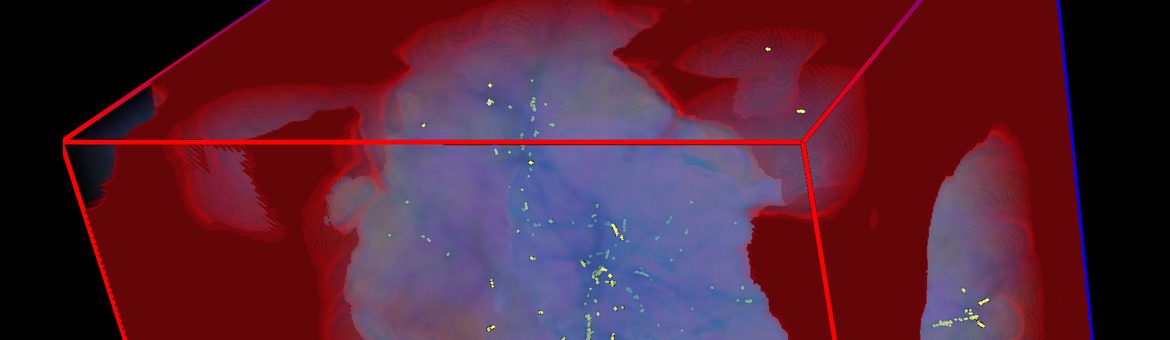

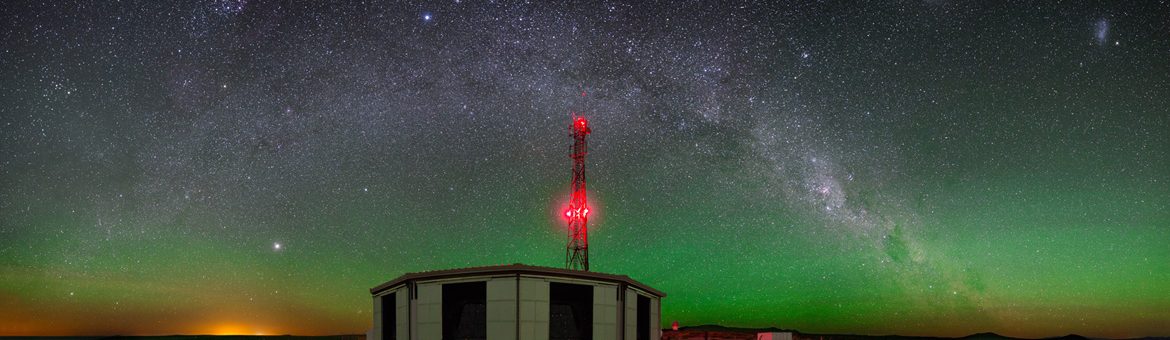
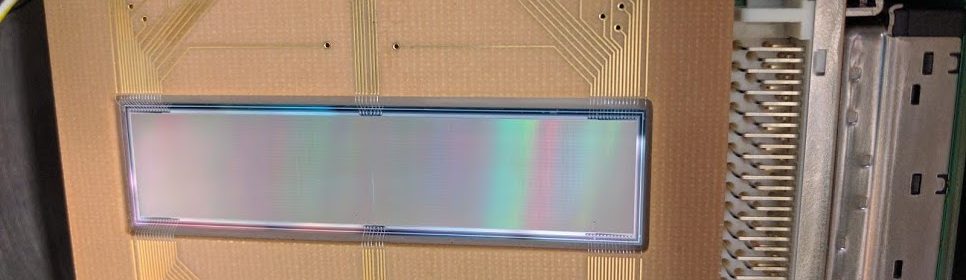
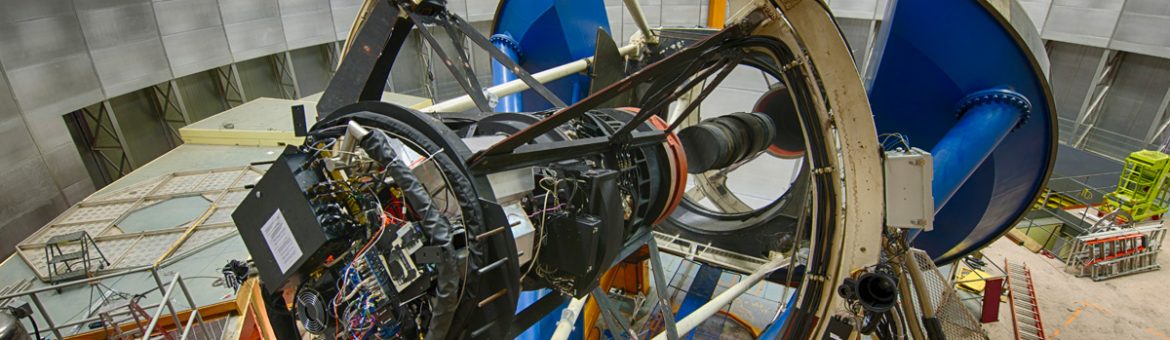
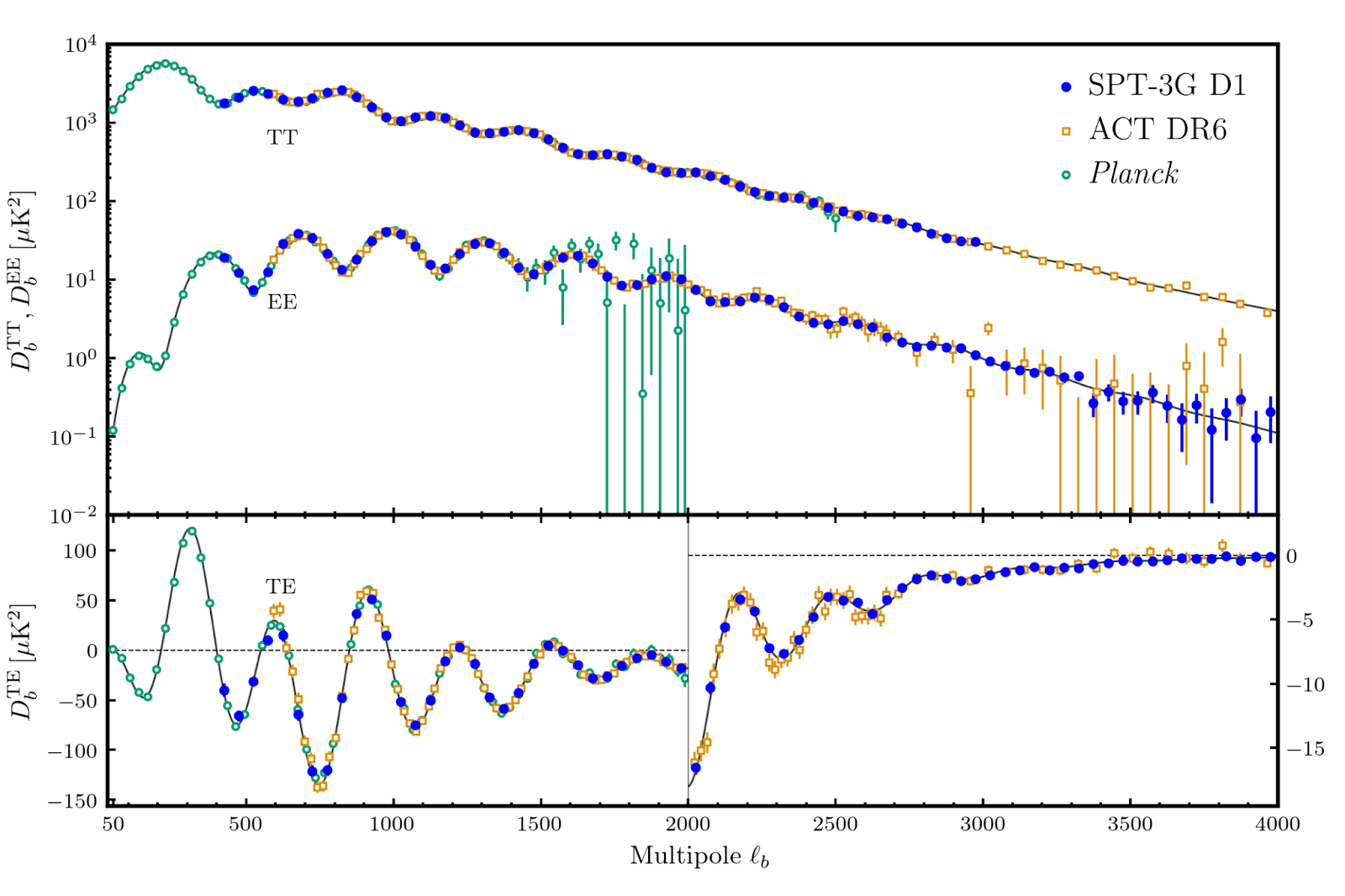
A compilation of measurements of the CMB temperature and polarization anisotropy from Camphuis et al. (2025) (SPT-3G collaboration).
The Cosmic Microwave Background (CMB) provides a snapshot of the universe at a time only 380,000 years after the Big Bang. The well-understood dynamics of the CMB enable precise calculation of its observable features, and directly connect new measurements to fundamental physics. These properties are what makes the CMB one of the most powerful pieces of evidence that we live in a geometrically flat universe, dominated by non-baryonic cold dark matter and dark energy, with large-scale structure having grown through gravitational instability seeded by quantum fluctuations from an earlier inflationary epoch. The next frontier of CMB research is to extract the wealth of cosmological information available from its polarization.
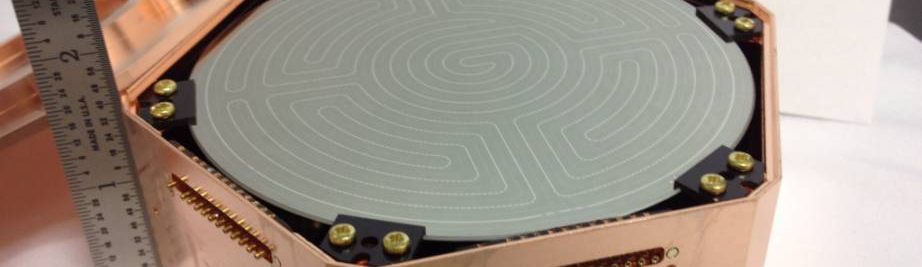
Fermilab scientists specialize in detector module design and assembly, detector testing, data analysis, data simulation, calibration hardware, and optical designs across several CMB experiments. Metamaterial lenses and optics for several experiments are fabricated in the Fermilab Metamaterial Laboratory.
Fermilab Personnel: Anderson, Benson, Bhimani, Datta, McMahon, Nguyen, Russier, Saunders, Simon, Sobrin, Young, Zebrowski.
Current Experiments
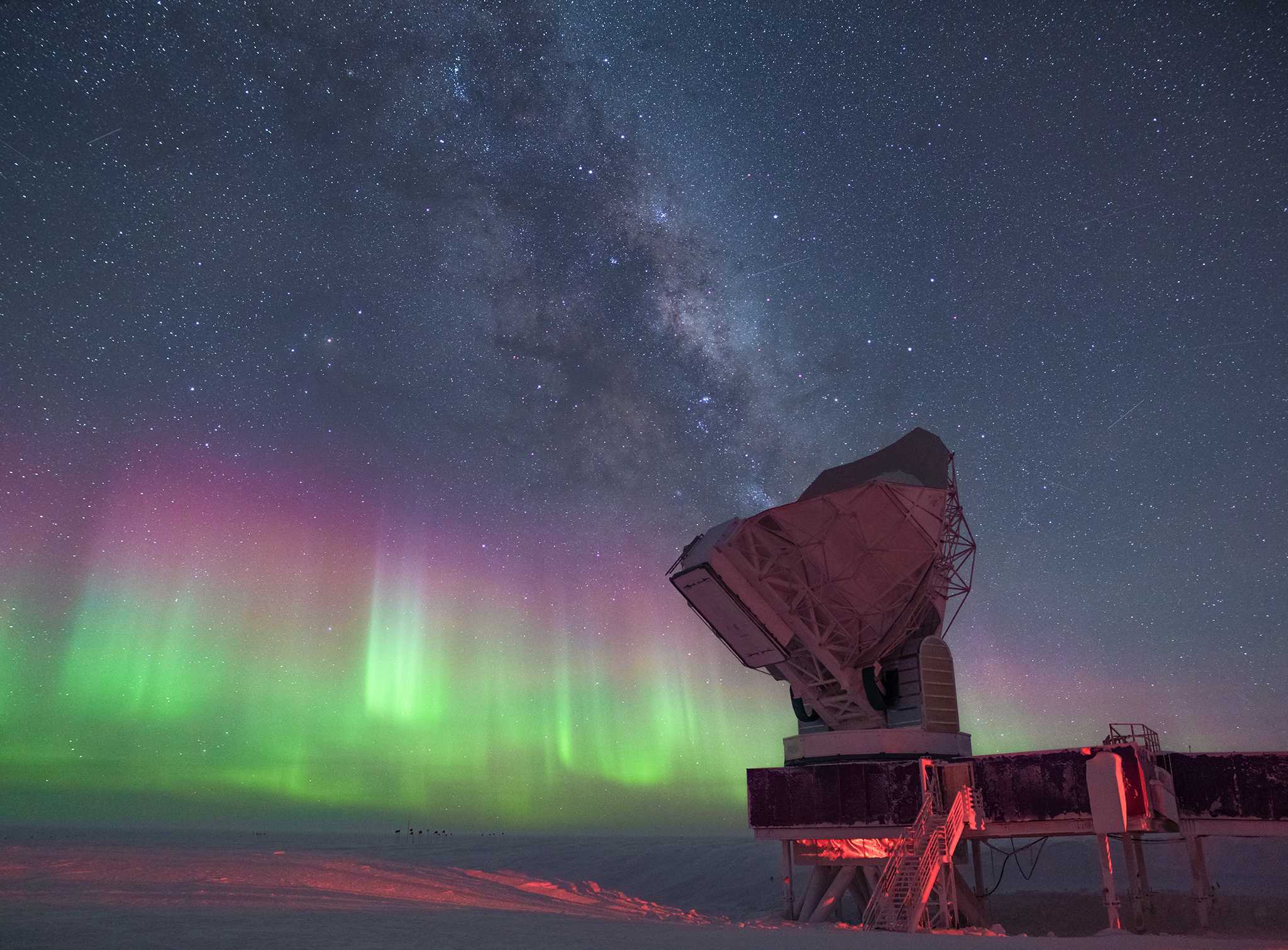
The South Pole Telescope (SPT) observing during the 2022 Austral winter season. Credit: Aman Chokshi.
The SPT-3G experiment on the South Pole Telescope (SPT) has been used to survey 10,000 sq deg of sky with an unprecedented combination of depth and angular resolution at 95, 150, and 220 GHz. Since 2019, SPT-3G has primarily observed a 1500 square degree “Main” survey, and in 2024, SPT-3G additionally completed a 10,000 square degree “Wide” survey. The “Main” and “Wide” surveys have a coadded sensitivity of 1.5 and 9 uK-arcmin, respectively, in CMB temperature units. Early results from SPT-3G have demonstrated how ground-based CMB measurements have begun to drive our current cosmological constraints, and sharpen our understanding of cosmological tensions, with results in the next years poised to reduce the allowed LCDM likelihood space by a factor of ~100. The early SPT-3G results have also been used to produce cluster catalogs with 20,000 clusters, including more than 5 per square degree in the “Main” survey; and find new classes of astrophysical transients. SPT-3G is also part of the South Pole Observatory (SPO) with the BICEP experiment, a coordinated observing and analysis program to probe cosmic Inflation and pursue increasing sensitive measurements of r, the ratio of tensor-to-scalar primordial fluctuations.
Scientists at Fermilab had leading roles in the construction of the SPT-3G camera, including its integration at the Silicon Detector Facility (SiDet), and leading or major roles on the operations and analysis of the SPT-3G experiment. Learn more about SPT and see recent publications here.
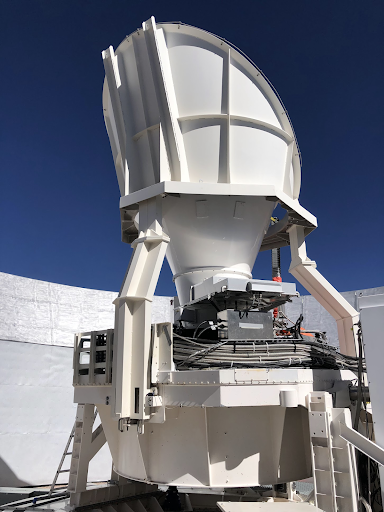
Six Small Aperture Telescopes will search for primordial inflationary perturbations. Credit: Adrian Lee
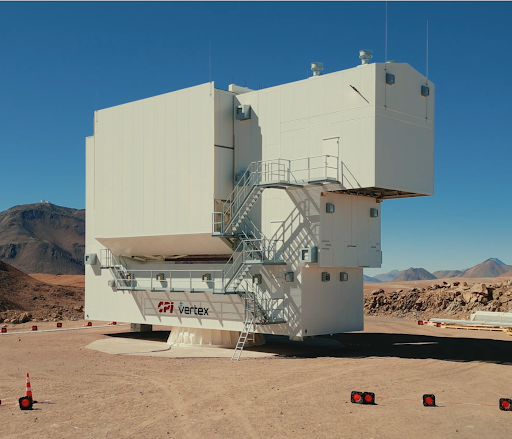
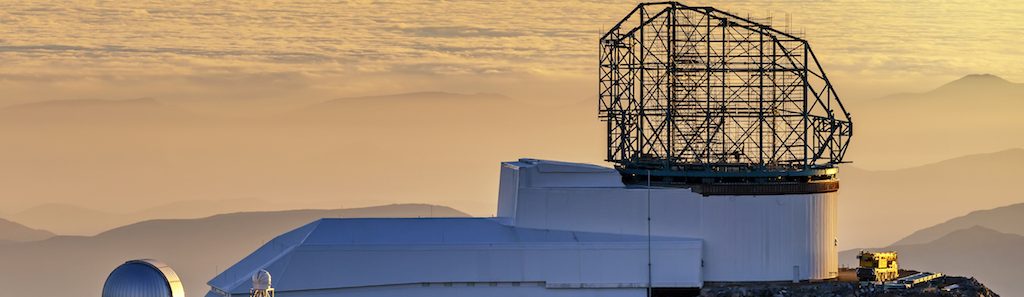
The Large Aperture Telescope is observing 70% of the sky with arcminute resolution. Credit: The Simons Observatory.
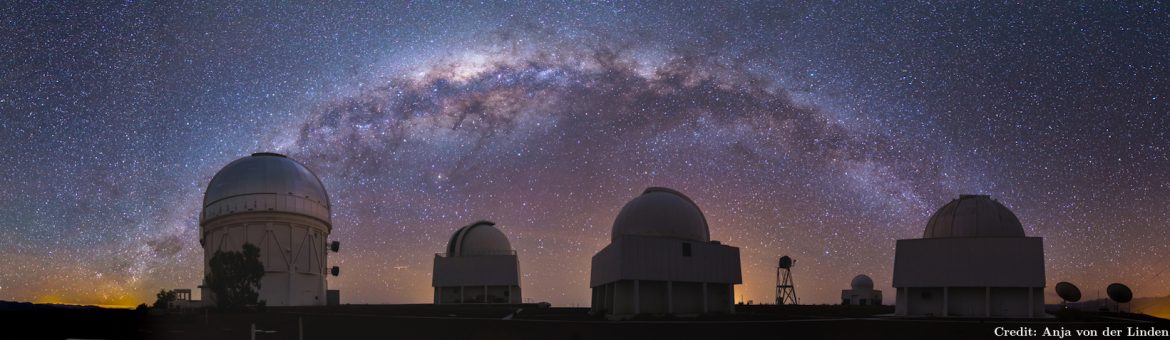
Simons Observatory is a cosmic microwave background (CMB) experiment located at an altitude of 5200 m in the Atacama Desert in Chile. SO has over 120,000 detectors with frequency coverage from 24-315 GHz split between one 6 m large aperture telescope (LAT) and six 0.42 m small aperture telescopes (SATs). SO is currently on-sky and observing. The SATs will search for the signature of cosmic inflation and are expected to improve current constraints on inflation by an order of magnitude. The LAT’s arcminute resolution enables a number of additional science goals including searching for light relics beyond the standard model, constraining sum of the neutrino masses, probing the transient millimeter-wave sky, and probing dark matter and dark energy through the formation of structure.
Scientists at Fermilab have major roles in the scientific analysis, the instrument calibration, modeling systematic effects, and in analyzing the instrument performance. Learn more about SO.
-
The South Pole Observatory (SPO) and SPT-3G+
The South Pole Observatory combines the power of the South Pole Telescope and the BICEP Array for observing the cosmic microwave background (CMB), the oldest detectable light in the Universe, at six different frequencies. The CMB dates from the Epoch of Recombination (about 380,000 years after the Big Bang) when the Universe cooled enough that neutral atoms could form, releasing photons from their plasma cage to travel unimpeded through space.
The new SPT-3G+ camera will increase the CMB sensitivity of SPT by nearly an order of magnitude. The SPT-3G+ data, in combination with lower-resolution measurements from the BICEP Array, as part of the South Pole Observatory (SPO), will improve constraints on Inflation by a factor of several compared to the best-constraints today, aiming to achieve an uncertainty on the tensor-to-scalar ratio, r, of 0.001. At this level, SPO would either rule out, or detect, the most compelling models of single-field, slow-roll Inflation (e.g., the Higgs and Starobinsky models), which predict an energy scale of Inflation near the grand unified theory (GUT) energy scale (~10^16 GeV), and a tensor-to-scalar ratio, r, in the range of 0.003-0.005.
Scientists at Fermilab have leading roles on the SPT-3G+ camera, including the camera design and integration, and the detector module design and fabrication.