




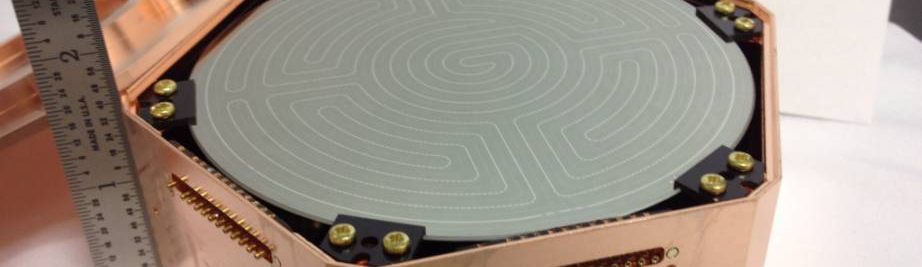
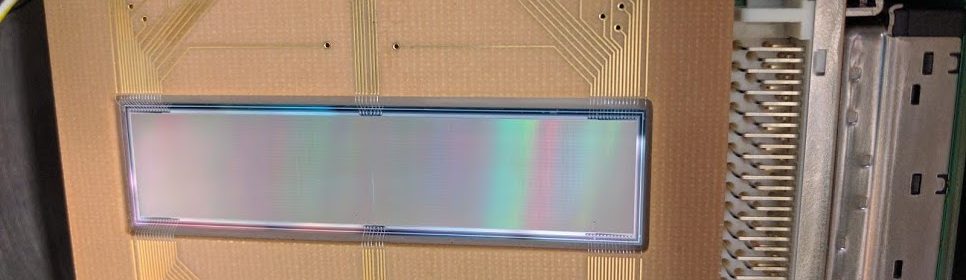
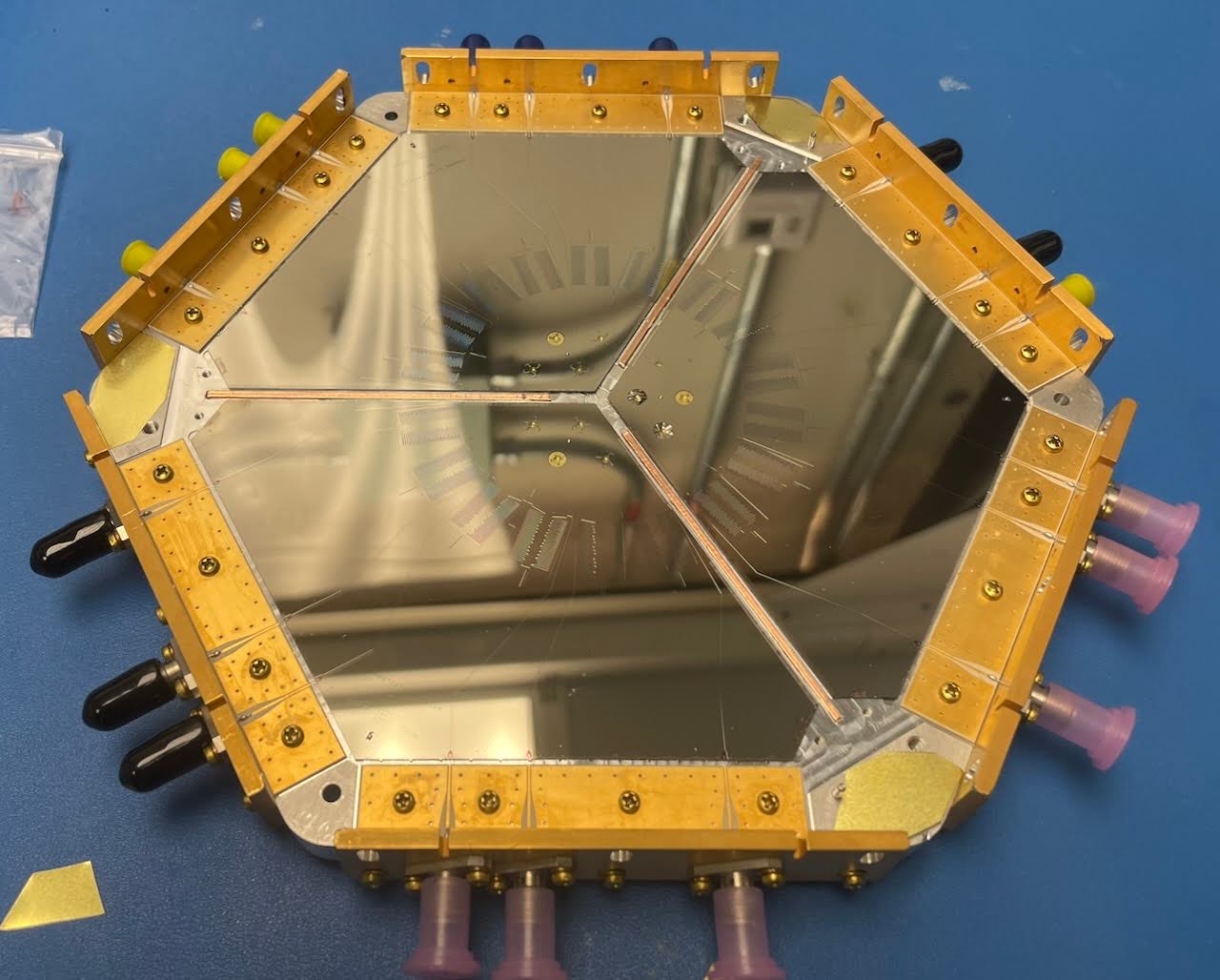
SPT-SLIM detector array (Credit: Adam Anderson).
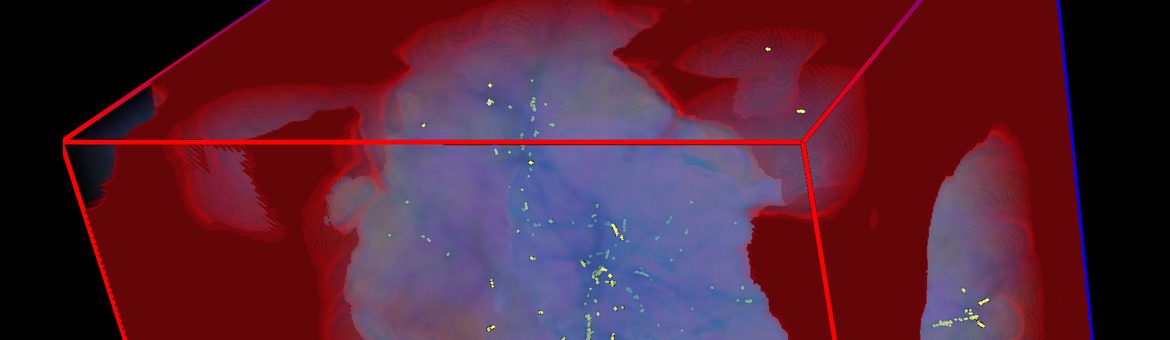
SPT-SLIM is a pathfinder experiment to develop millimeter-wave on-chip spectrometers and perform a line-intensity mapping (LIM) survey with them using the 10-meter South Pole Telescope (SPT). LIM is a relatively new observational probe that involves making low-resolution maps of the redshifted emission of an atomic or molecular line as a function of frequency using a spectrometer, in order to probe large-scale structure at high redshifts. The rotational transitions of CO are particularly attractive lines for LIM because they are very bright and redshift into the same frequency bands used by CMB experiments.
SPT-SLIM has developed a highly scalable on-chip filterbank spectrometer architecture that operates between 110 and 180 GHz with a spectral resolution of R~100. Each spectrometer channel is read out using a kinetic inductance detector (KID), a highly multiplexed superconducting detector. The project built a cryostat and a novel KID readout system called RF-ICE, and deployed the system on the South Pole Telescope to observe CO during the 2024-2025 austral summer season, where it performed commissioning observations of bright mm-wave sources in the Galaxy. We are currently fabricating improved detectors expected to deploy on the SPT in the 2026-2027 austral summer season.
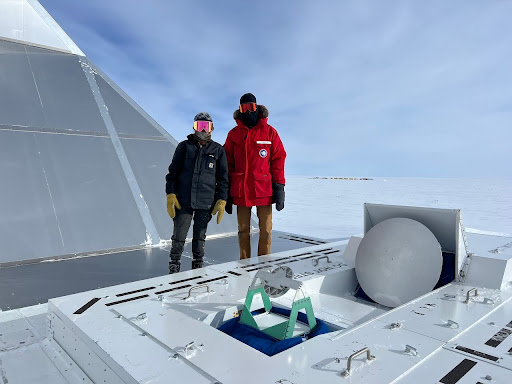
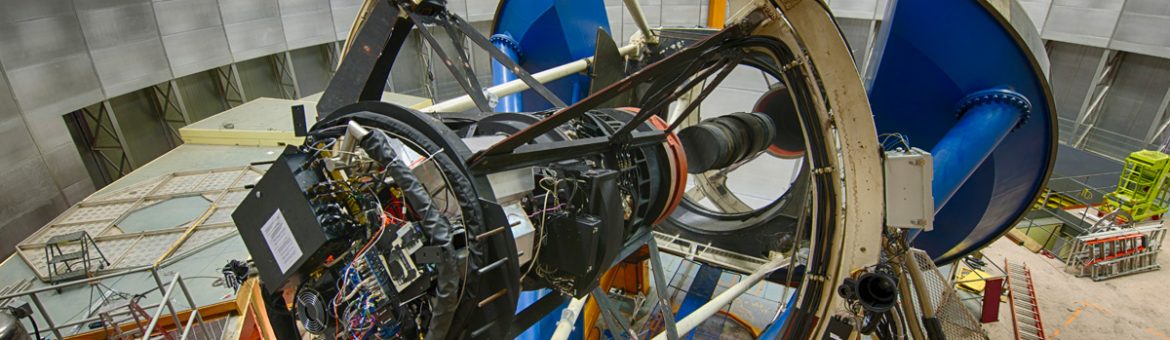
SPT-SLIM collaborators Karia Dibert (Caltech) and Adam Anderson (Fermilab) installing secondary optics on the South Pole Telescope (Credit: Simeon Bash).
The project is a collaboration between Fermilab, Argonne National Laboratory, the University of Arizona, Boston University, Caltech, Cardiff University, the University of Chicago, Harvard University, and McGill University. Fermilab designed and built the SPT-SLIM cryostat, commissioned the instrument in the lab, and now manages the deployment and operations at the South Pole and contributes to lab testing of detectors. We also provide high-level management of the SPT-SLIM project.
Fermilab Personnel: Anderson, Benson, Young, Zebrowski