

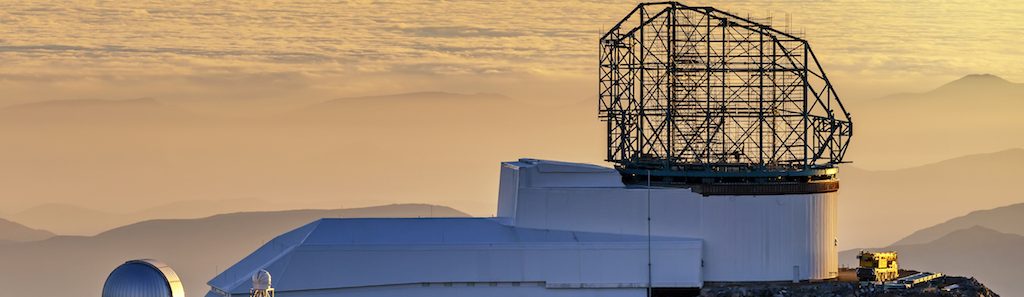
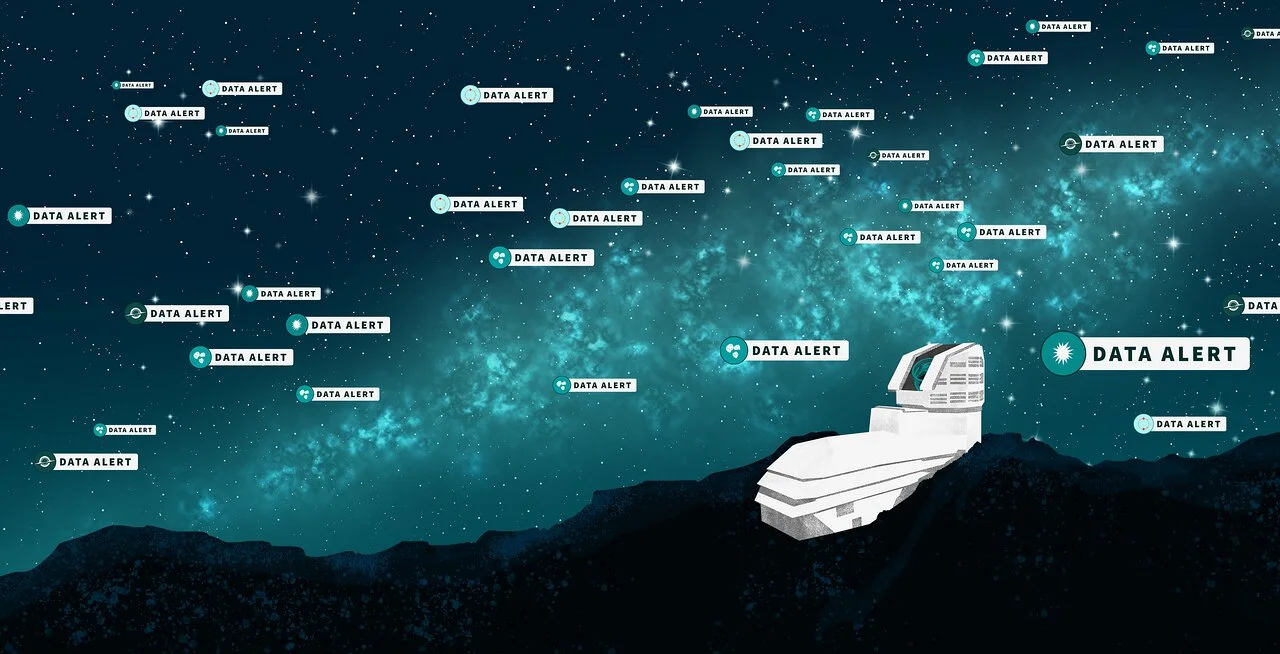
This artist’s illustration represents the start of the alert stream from NSF–DOE Vera C. Rubin Observatory. The summit facility is shown on a rocky ridge. The night sky features stars and the glittering band of the Milky Way Galaxy. The sky is populated with multiple alert “pings,” representing individual alerts from Rubin that something in the sky has changed in brightness or position. Different icons represent various types of alerts, including asteroids, supernovae, active galactic nuclei, and variable stars. Credit: NSF–DOE Vera C. Rubin Observatory/NOIRLab/SLAC/AURA/P. Marenfeld/J. Pinto
NSF–DOE Rubin Observatory has issued its first scientific alerts, marking a historic milestone in astrophysics. Expected to increase to seven million alerts per night, these first alerts start a new era of dynamic, real-time observation of the night sky. Fermilab helped to process early Rubin data into a set of template reference images that could be used as templates to “difference” the night sky. Read more about Rubin First Alerts here.