
Join the CPC’s own theoretical physicist Dan Hooper as he joins with NYU PhD student Shalma Wegsman to answer some of the deepest questions about dark matter, black holes, quantum mechanics, and more. “Why this Universe?” is a new podcast that seeks to break down some of the biggest ideas in physics into easily digestible… More »
Author Archive
In an article submitted to Physical Review D, CPC members Noah Kurinsky and Gordan Krnjaic collaborate with Dan Baxter (KICP) and Yoni Kahn (UIUC) to present a novel interpretation of excess events observed at various low-threshold dark matter searches. They found that the anomalous results across various detectors operating in dramatically different experimental conditions could… More »
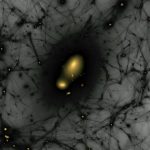
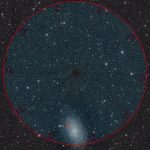
Over the past five years, the Dark Energy Survey, a DOE-funded project led by Fermilab, has revolutionized our view of small satellite galaxies. DES discovered a large number of tiny galaxies close to the Milky Way’s largest satellites, the Magellanic Clouds, suggesting that multiple galaxies may have been captured by the Milky Way at the… More »
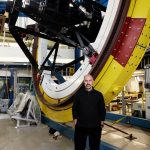
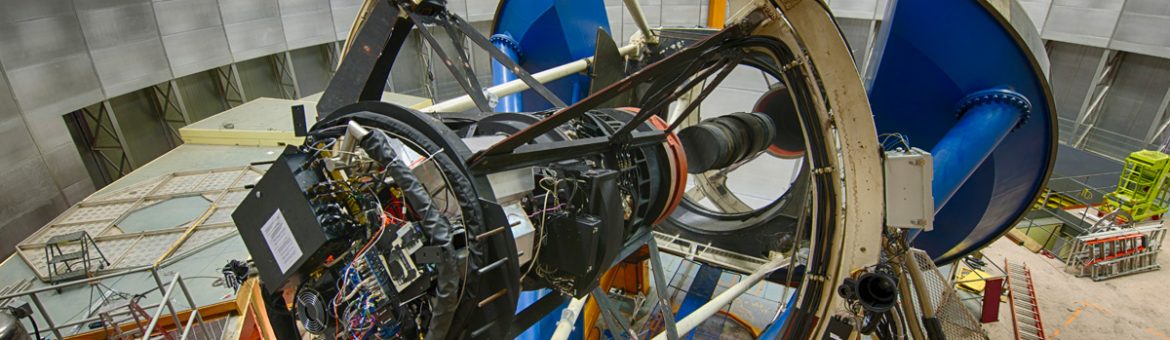
The Dark Energy Spectroscopic Instrument seeks to further our cosmic understanding by creating the largest 3-D map of galaxies to date. Below is a press release issued by Lawrence Berkeley National Laboratory announcing first light for this extraordinary instrument. The U.S. Department of Energy’s Fermi National Accelerator Laboratory is a key player in the construction of… More »
The Department of Energy has awarded Fermilab and University of Chicago scientist Josh Frieman $1 million over three years as part of the inaugural Office of Science Distinguished Scientist Fellowship program. Office of Science distinguished scientist fellows were chosen from nominations submitted by nine U.S. national laboratories. Frieman is one of only five scientists selected,… More »
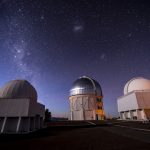
Why is our universe accelerating in its expansion? If Einstein’s theory of general relativity is correct, then the dark energy that drives this expansion accounts for nearly 70% of the total energy in the universe. However, precise measurements of the history of this expansion may reveal that new dynamic forces are in play. The Dark… More »
The Dark Energy Spectroscopic Instrument seeks to further our cosmic understanding by creating the largest 3-D map of galaxies to date. Below is a press release issued by Lawrence Berkeley National Laboratory announcing first light for the optical lenses of this extraordinary instrument. The U.S. Department of Energy’s Fermi National Accelerator Laboratory is a key player in… More »
Fermilab is providing technology and expertise for the SuperCDMS SNOLAB project, which will expand the hunt for dark matter to particles with properties not visible to any other experiment. The U.S. Department of Energy Office of Science and the National Science Foundation have approved funding and start of construction for the SuperCDMS SNOLAB experiment, which… More »
New result draws on 30 years of research and development and begins the definitive search for axion particles Forty years ago, scientists theorized a new kind of low-mass particle that could solve one of the enduring mysteries of nature: what dark matter is made of. Now a new chapter in the search for that particle… More »
A press release on the Dark Energy Spectroscopic Instrument (DESI) was issued by the DESI collaboration. The U.S. Department of Energy’s Fermilab is a member of the collaboration, bringing expertise gained during the design, building and operation of the Dark Energy Camera to this next-generation instrument. Fermilab scientists are managing key elements of the construction, including the heavy… More »