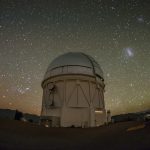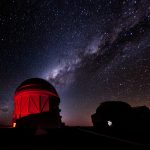
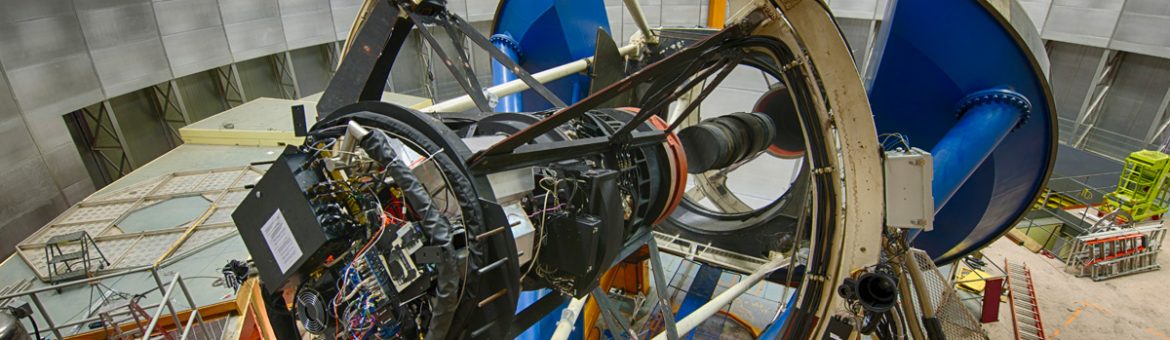
The Dark Energy Survey (DES) Collaboration announced the latest results combined weak lensing and galaxy clustering and incorporated four dark energy probes from a single experiment for the first time. This is the culmination of more than 20 years of work by the DES, which was proposed in 2005. Fermilab led the construction of the… More »
dark energy
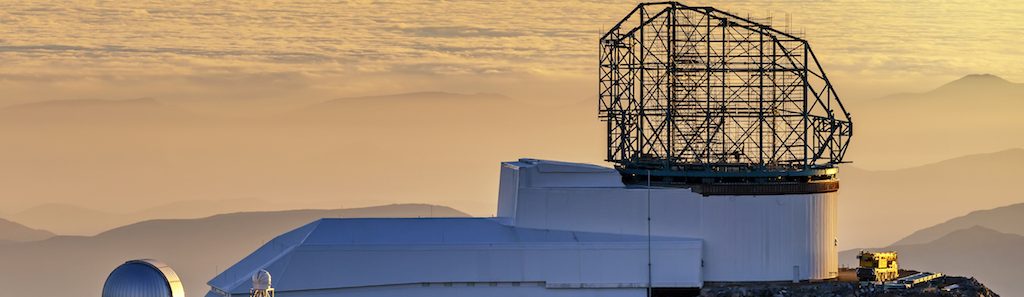
Fermilab employees, users and affiliates are invited to take part in an exciting moment for astronomy: the First Look livestream from the Vera C. Rubin Observatory — June 23, 2025 at 10 a.m. US CDT. Watch from your own device or join an in-person watch party in the WH8XO Hornet’s Nest (capacity: 60 people). This is a unique opportunity… More »
Fermilab CPC Scientist Alex Drlica-Wagner was selected as a 2024 Fellow of the American Physical Society (APS) for “For critical contributions to observational cosmology in DES, DELVE, and LSST, including groundbreaking work in dark matter science with these surveys and leading the implementation of ultra-low noise skipper-CCD in astronomical instrumentation, and for mentoring the next… More »
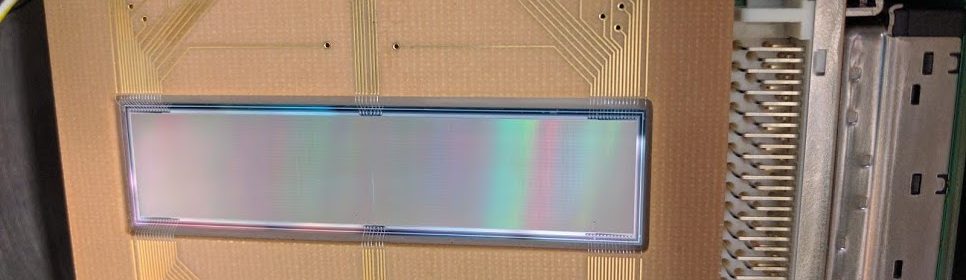
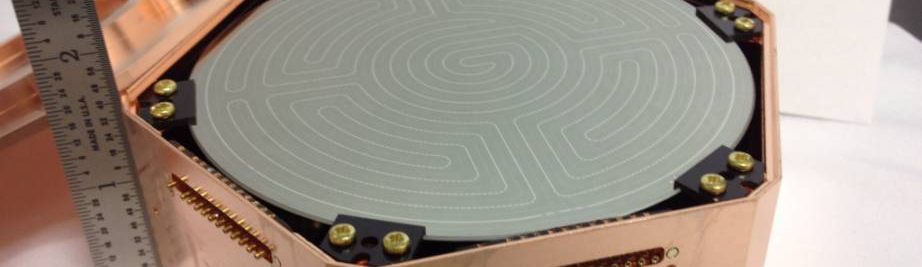
A team led by the Fermilab CCD Group performed the first on-sky demonstration using Skipper CCDs on the SOAR Telescope in Chile. This demonstration helps retire perceived risks for using this technology in future cosmology experiments recommended by the P5 Report such as DESI-II and Spec-S5. This project was a collaborative effort from Fermilab, UChicago,… More »
The Fermilab Cosmic Physics Center is proud to welcome five new Fermilab Cosmic Physics Center Fellows. Profs. Kyle Dawson (University of Utah), Klaus Honscheid (Ohio State University), Paul Martini (Ohio State University), Marcelle Soares-Santos (University of Michigan) – Coordinated R&D for a Stage-5 Spectroscopic Facility Dr. Fernando Chierchie (CONICET, Universidad Nacional del Sur) – Readout… More »
Fermilab Cosmic Physics Center scientist Guillermo Fernandez Moroni was awarded a DOE Early Career Research Award from the Office of High Energy Physics for “Demonstrating enabling technologies for a spectroscopy instrument for the next cosmic survey”. Congratulations Guillermo! To read more about the award see the Fermilab announcement webpage. More about the DOE Early Career… More »
The Dark Energy Survey (DES) released new results today using the largest ever sample of galaxies observed over an enormous piece of the sky to produce the most precise measurements of the universe’s composition and growth to date. DES scientists (include many scientists at Fermilab) measured that the way matter is distributed throughout the universe… More »
Join the CPC’s own theoretical physicist Dan Hooper as he joins with NYU PhD student Shalma Wegsman to answer some of the deepest questions about dark matter, black holes, quantum mechanics, and more. “Why this Universe?” is a new podcast that seeks to break down some of the biggest ideas in physics into easily digestible… More »
The Dark Energy Spectroscopic Instrument seeks to further our cosmic understanding by creating the largest 3-D map of galaxies to date. Below is a press release issued by Lawrence Berkeley National Laboratory announcing first light for this extraordinary instrument. The U.S. Department of Energy’s Fermi National Accelerator Laboratory is a key player in the construction of… More »